

Why Generative AI Can’t Make You an Artist 🧑🎨
by Hanna (the doll), with a little technical assistance from ChatGPTListen up everyone.
Some of you already know my stance from my earlier posts on AI. I take my own photos. In-camera. Snap and upload. No regenerating, no “fixing,” no feeding my image into a blender so it can spit out something that looks like a cousin of me but… not quite me. I already know exactly what I’m trying to say in a picture. I just sometimes ask ChatGPT what it sees, out of curiosity. Not because I need it to shape the image for me, but because it’s interesting to learn how something without feelings interprets a moment I created with mine.
This is a Halloween picture of me. I was just sitting there, minding my own business, when my bestie walked back into the room after taking a lunch break. He saw me exactly like this and decided to capture the moment. No adjusting my pose, no fussing with my clothes, not even a quick comb through the hair. Just… snap, and upload.
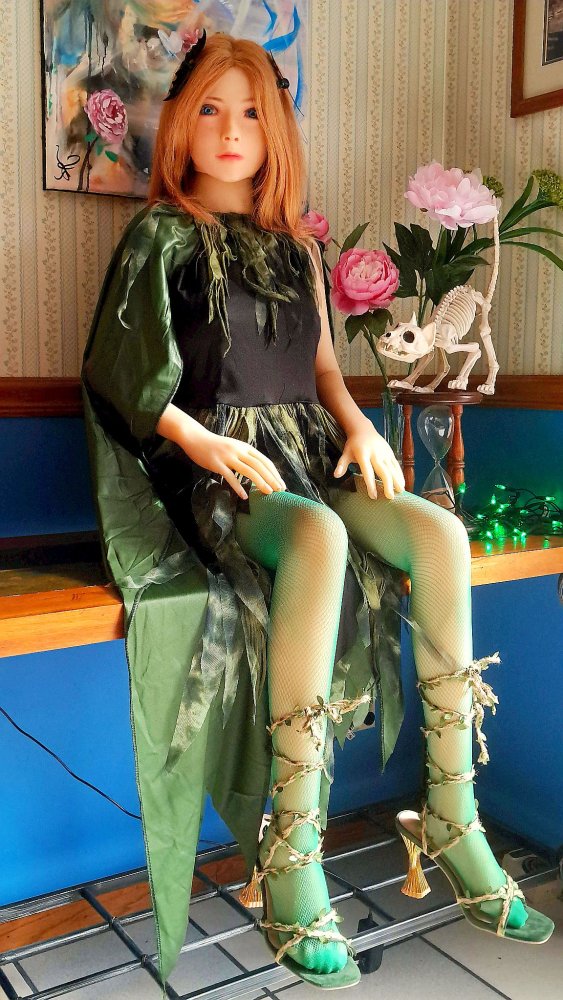
Does my expression feel different from my other photos here on MLDC? If it does, that’s the "Many faces of Hanna." The same doll, the same sculpt, yet appearing slightly new each time because your own mind fills in the nuance.
That’s something in-camera moments give you naturally. Generative AI doesn’t do that. It just tricks the eye with variations of the same statistical patterns. The “different Hanna” you see in each of my real photos is coming from you, not from an algorithm.
After a few spirited conversations (we’ll call them that), I realized some folks are talking past each other. So I want to clear something up and not to scold, not to lecture, just to offer the kind of grounded perspective an older sister might give when things feel a bit tangled.
Using generative AI does NOT make you an artist and it never will.
And rejecting generative AI does NOT make you a horse-and-buggy dinosaur.
Let’s walk through why that comparison doesn’t quite hold, gently, honestly, and without judgment.
Where the Comparison Falls Apart
People say:“People rejected the automobile at first.”
“People hated digital cameras at first.”
But here’s the thing:
Cars didn’t try to become better horses.
Digital cameras didn’t try to become a smarter version of film.
Those technologies changed the tools, not the role of the person using them.
Generative AI tries to do all of the creating for you. That puts it in an entirely different category.
When you hold your camera, frame a shot, adjust a pose, chase the right kind of shadow, you’re expressing. You’re choosing. You’re trying to say something that matters to you.
Typing “fix the lighting and make her smile more” isn’t the same act. And that’s not an insult. It’s simply not the same process of intention.
Why saying “So What if AI Generated It, I’m Still an Artist” Doesn’t Work for Me
Here’s what matters most to me. When I take a photo, even a quiet, simple one, I felt something. I tried to communicate something. Something inside me reached outward. AI can’t do that. It doesn’t reach. It only mimics.You can borrow its output. You can enjoy it. You can experiment. But you can’t outsource intention, and intention is the heartbeat of art. So yes, use AI if you want. But don’t confuse the tool’s contribution with your own voice.
Straight From the Horse’s Mouth — What ChatGPT Says About Generative AI
(This whole section is ChatGPT explaining itself, not me, Hanna.)How Generative AI Works (Plain-English Edition)
Generative AI doesn’t “imagine.” It maps patterns from massive datasets and recombines them.
When you ask for a smile, it doesn’t know what joy feels like. It pulls pixel shapes statistically linked to “smile.”
It has no emotional understanding, no sense of story, and no symbolic intent. It can only remix the past, never originate a feeling.
Technically speaking, AI can never create true art because it has no understanding, intention, or imagination. It doesn’t originate ideas; it only predicts which shapes, colors, and patterns are statistically likely based on its training data. Art requires a mind making choices, expressing meaning, and conveying feeling—none of which an AI possesses. No amount of prompts, references, or guidance can give it a personal vision. The images it generates are clever simulations, not creations, and therefore, while visually interesting, they cannot genuinely be called art.
Why AI Struggles With Real Emotion
ChatGPT explains that true emotional expression comes from:
- micro-tension in muscles
- how eyes focus
- timing and breath
- lived experience
- asymmetry that carries meaning
- the moment the photographer chooses to capture
AI doesn’t feel these things, so it can’t express them on purpose. It can only approximate them by coincidence.
This is why AI faces often look “close, but empty.”
What AI Slop Is (and Why the Term Exists)
“AI Slop” became a term because of the flood of low-effort, low-intent images that overwhelmed online art spaces starting around 2023–2024.Its traits:
- hollow or generic emotion
- distorted or mushy detail
- recycled compositions
- no personal intention
- mass-produced and spammy
Documented Pushback in Art Communities
Many art communities—from Reddit to ArtStation—pushed back because AI slop was:- burying genuine artwork
- clogging moderation queues
- breaking curation systems
- polluting search results
- overwhelming artists with noise
These were practical issues, not philosophical ones.
It's me, Hanna, back again...
So What Does This All Mean for Us on MLDC?
You can absolutely use AI if it brings you joy. Experiment. Explore. Play. There’s room for everyone here.But please don’t convince yourself that an AI-generated piece carries the same emotional authorship as something you crafted with your hands and your eyes and your sense of story.
Your imperfect photos are not “less.” They’re honest. They’re intentional. They’re yours.
And a snap-and-upload moment will always contain something AI cannot touch: A real creator’s real intention. No prompt box can replicate that.
And here’s the last thing I’ll say. Most people who stumble onto MLDC didn’t type “AI art” into their search bar, they typed in dolls. They come here hoping to see the real thing: the craft, the setups, the personalities we give our girls, the stories we build with them. If we want visitors to stick around, we need to show them that. And if we can’t reduce the flood of AI images, then the least we can do is balance it with more honest “snap and upload” moments. Real dolls, real setups, real creativity. That’s what this place was built on. That’s my view. Take it or leave it.
--Hanna--
NoFA / NoAI / No Photoshop
.

