


At first glance, she appears to be exactly who she is meant to be: Captain’s Yeoman Janice Rand, stepping into the warm glow of a holiday reception aboard the USS Enterprise. The posture is composed but relaxed, the expression poised with a quiet confidence that feels distinctly Star Trek: The Original Series. This is not the Rand of duty shifts and clipped bridge dialogue, but the woman who exists just beyond the frame of canon, off duty, still Starfleet, still unmistakably herself.
 Janice is an OOAK (One of a Kind) classic 1:6 scale fashion figure with fully articulated arms and legs, including well-hidden knee joints that remain nearly invisible when straightened. This subtle engineering gives the figure an unusually natural stance, allowing her to stand or pose without the mechanical distraction seen in many modern dolls. The articulation is smooth and deliberate, suggesting a body type produced to balance poseability with visual realism rather than exaggerated play features. Her proportions align closely with late-20th-century Barbie standards, reinforcing the quiet reveal that comes later.
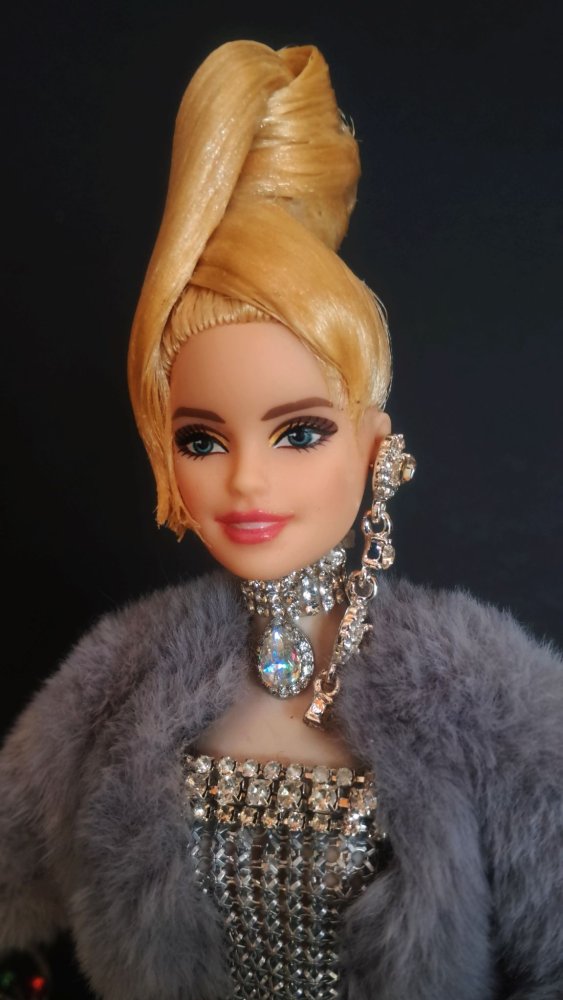 Her hair is blonde, styled into a sculpted beehive that unmistakably echoes Janice Rand’s on-screen appearance. Unlike many custom dolls where hairstyles are fixed with visible glue or stiffened fibers, this hair retains a clean, almost factory-finished quality. The strands are distinct and smooth, with enough firmness to hold their shape while avoiding the chalky residue associated with heavy adhesives. The result is a hairstyle that looks intentional, period-correct, and surprisingly elegant, as though it were always meant to exist this way.
 The dress is the heart of the piece and the reason Janice commands attention. It is constructed from genuine metal mesh, not a lightweight imitation or fabric print designed to mimic metallic shine. The mesh is heavy, cool to the touch, and exceptionally fluid, draping over her form with a gravity that immediately sets it apart from typical doll-scale garments. At just over three ounces in 1:6 scale, the dress behaves like a real gown rather than a miniature costume, conforming to the contours of the figure and pooling naturally along the legs. This weight and flexibility are hallmarks of authentic Whiting & Davis–style mesh, long prized for its durability, sensual movement, and unmistakable sound and feel.
Historically, metal mesh garments occupy a fascinating intersection between fashion, craftsmanship, and industrial innovation. Whiting & Davis, founded in the late nineteenth century, perfected the production of articulated metal mesh handbags and, later, garments that became icons of 1920s and 1930s glamour. By the mid-twentieth century, their mesh dresses and gowns were rare, expensive, and unforgettable, worn by performers and socialites who wanted clothing that shimmered like jewelry and moved like liquid. These gowns were heavy, sometimes uncomfortably so, but they were also statements, objects as much as apparel, demanding attention and reverence.
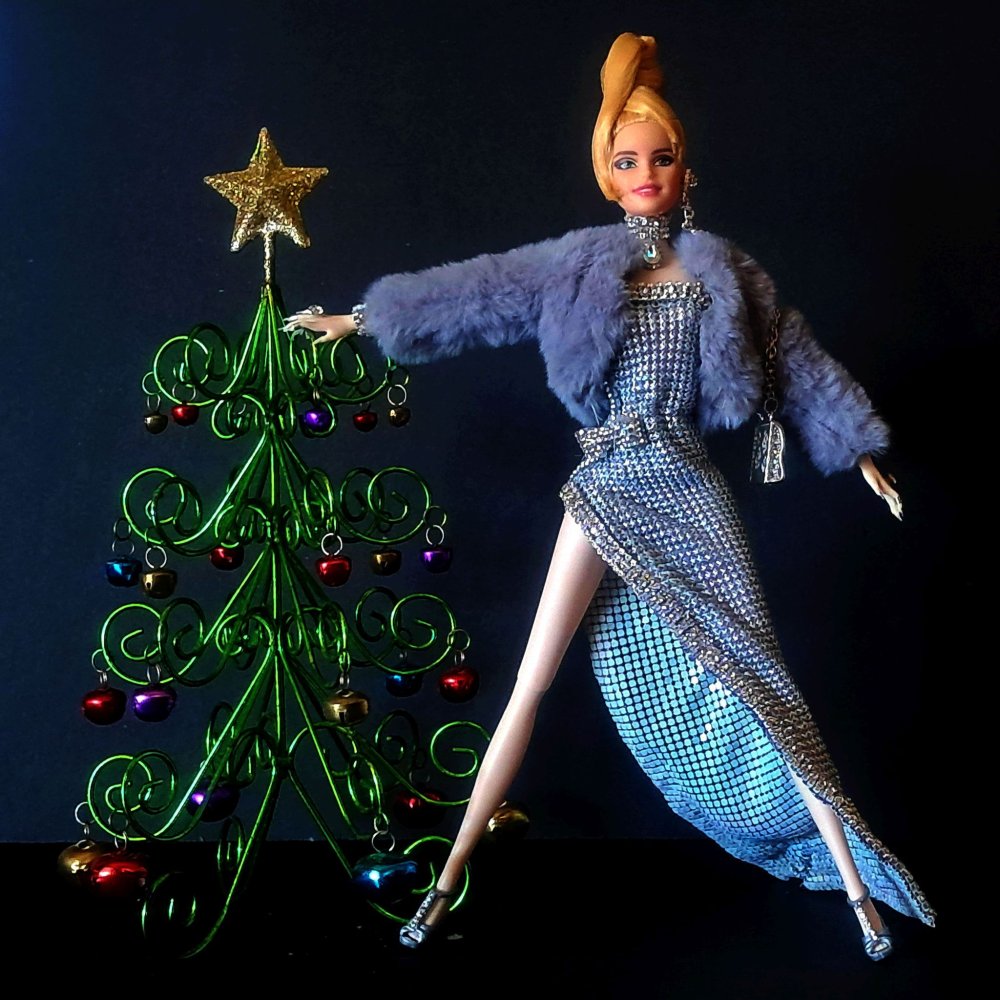 The visual language of metal mesh never fully disappeared. By the 1960s, chainmail-like and metallic costumes began appearing in science fiction, reflecting both the Space Age obsession with modernity and a revival of interest in ancient armor aesthetics. In Star Trek: The Original Series, alien cultures were often depicted using metallic tunics and mesh-like garments, most notably the Ornans in “Errand of Mercy,” whose attire suggested both ceremonial armor and futuristic minimalism. These costumes bridged past and future, echoing medieval chainmail while signaling technological advancement. In that context, a metal mesh gown aboard the Enterprise feels entirely plausible, especially as a diplomatic or ceremonial gift.
Within this story, the dress is said to have been a gift from the Organians, presented quietly and without explanation after the signing of the Organian Peace Treaty. To them, the mesh is not fashion but symbolism: interlocking links representing unity, strength through connection, and the balance between rigidity and grace. To Starfleet, it is an exquisite curiosity. To Janice Rand, it is something else entirely, a reminder that she exists not only as an extension of command but as an individual worthy of beauty and recognition.
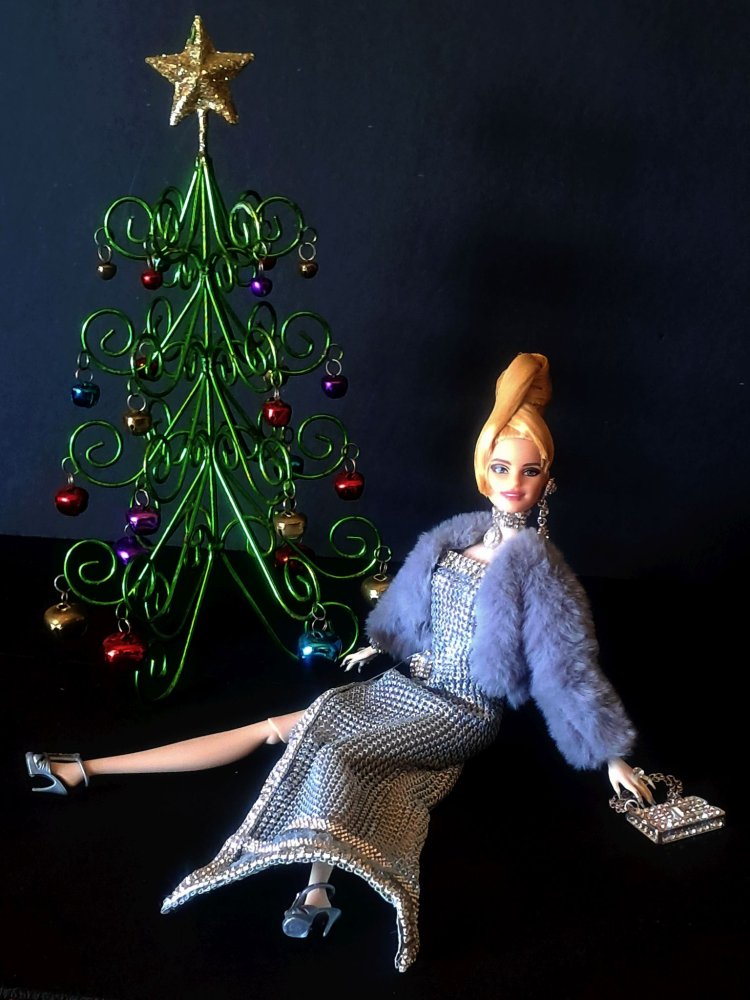 And yet, as the eye lingers, the illusion softens in a gentle, knowing way. The flawless articulation, the unmistakable proportions, the subtle engineering choices of the body reveal the truth. This is, at her core, a Barbie doll, transformed, elevated, and recontextualized through material, styling, and narrative. The revelation does not diminish the piece; it enhances it. The juxtaposition of a mass-produced fashion doll with a dress that carries the weight and history of real metalwork becomes the final, quiet brilliance of the project.
This Janice Rand exists in the space between fandom and fine object, between plaything and artifact. She is not merely dressed for a Christmas ball among the stars. She is a meditation on glamour, labor, and imagination, on how stories, materials, and memory can turn even the most familiar forms into something rare and resonant.
 Well anyway, here is the story behind the story.
My bestie picked up Janice at an antique mall two weeks ago. A departure from his usual treasure hunting in thrift shops. His wife collects Whiting and Davis purses so he immediately knew the dress was custom made from a Whiting and Davis purse. (If you don't know what a Whiting and Davis purse or dress is, Google it)
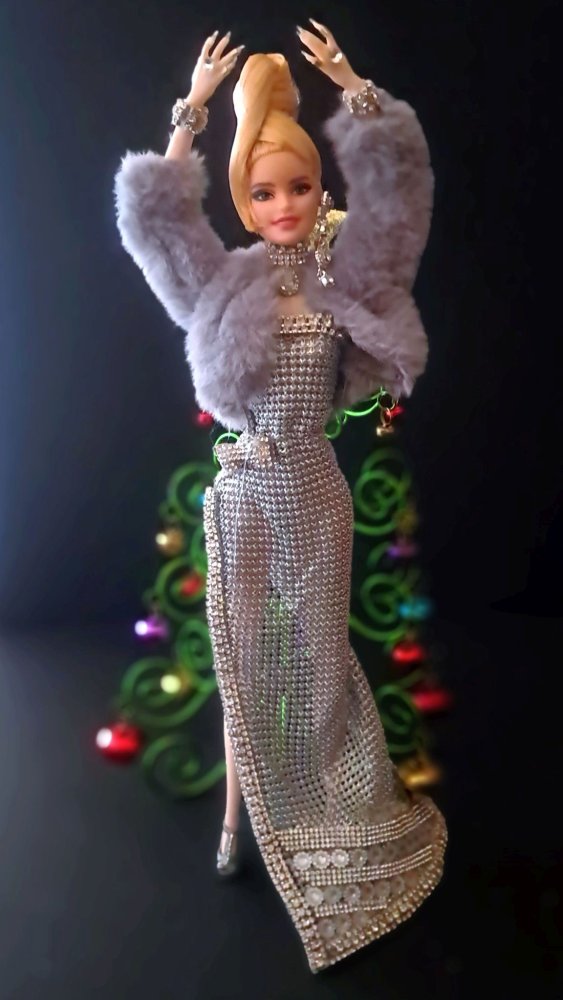
Anyway, he just wanted to do a photoshoot in front of a black background to contrast the silver dress. When he saw the black background in the pictures, he thought, "It needs stars." And then he though, "Who has a beehive hairdo?" See where this is going. Well anyway, now you can see how my bestie comes up with his doll stories. He doesn't plan anything. It just comes together. And that's why he rarely does AI. If we weren't in this hectic holiday season, he would have done Holiday Glamour Amongst the Stars using his usual rear projection instead of AI for the background. But in this case, he uploaded Picture #5 and instructed AI not to change anything except for the background. It followed those instructions, but it did take 8 attempts to get the starship window looking halfway decent. he still thinks it is too big but he said he can live with it.
I guess his next mission is to scour the thrift stores for a Star Trek Barbie to score a uniform for Yeoman Janice Rand. 😏
NoFA / NoAI / No Photoshop
.
Historically, metal mesh garments occupy a fascinating intersection between fashion, craftsmanship, and industrial innovation. Whiting & Davis, founded in the late nineteenth century, perfected the production of articulated metal mesh handbags and, later, garments that became icons of 1920s and 1930s glamour. By the mid-twentieth century, their mesh dresses and gowns were rare, expensive, and unforgettable, worn by performers and socialites who wanted clothing that shimmered like jewelry and moved like liquid. These gowns were heavy, sometimes uncomfortably so, but they were also statements, objects as much as apparel, demanding attention and reverence.
Within this story, the dress is said to have been a gift from the Organians, presented quietly and without explanation after the signing of the Organian Peace Treaty. To them, the mesh is not fashion but symbolism: interlocking links representing unity, strength through connection, and the balance between rigidity and grace. To Starfleet, it is an exquisite curiosity. To Janice Rand, it is something else entirely, a reminder that she exists not only as an extension of command but as an individual worthy of beauty and recognition.
This Janice Rand exists in the space between fandom and fine object, between plaything and artifact. She is not merely dressed for a Christmas ball among the stars. She is a meditation on glamour, labor, and imagination, on how stories, materials, and memory can turn even the most familiar forms into something rare and resonant.
My bestie picked up Janice at an antique mall two weeks ago. A departure from his usual treasure hunting in thrift shops. His wife collects Whiting and Davis purses so he immediately knew the dress was custom made from a Whiting and Davis purse. (If you don't know what a Whiting and Davis purse or dress is, Google it)
Anyway, he just wanted to do a photoshoot in front of a black background to contrast the silver dress. When he saw the black background in the pictures, he thought, "It needs stars." And then he though, "Who has a beehive hairdo?" See where this is going. Well anyway, now you can see how my bestie comes up with his doll stories. He doesn't plan anything. It just comes together. And that's why he rarely does AI. If we weren't in this hectic holiday season, he would have done Holiday Glamour Amongst the Stars using his usual rear projection instead of AI for the background. But in this case, he uploaded Picture #5 and instructed AI not to change anything except for the background. It followed those instructions, but it did take 8 attempts to get the starship window looking halfway decent. he still thinks it is too big but he said he can live with it.
I guess his next mission is to scour the thrift stores for a Star Trek Barbie to score a uniform for Yeoman Janice Rand. 😏
NoFA / NoAI / No Photoshop
.
