

The Origins of the word ‘numpty' can be traced back 200 years earlier than previously thought
The origins of the word ‘numpty’, a popular term of mild abuse, have been traced back to 1794, backdating its current recorded appearance in the OED by almost 200 years.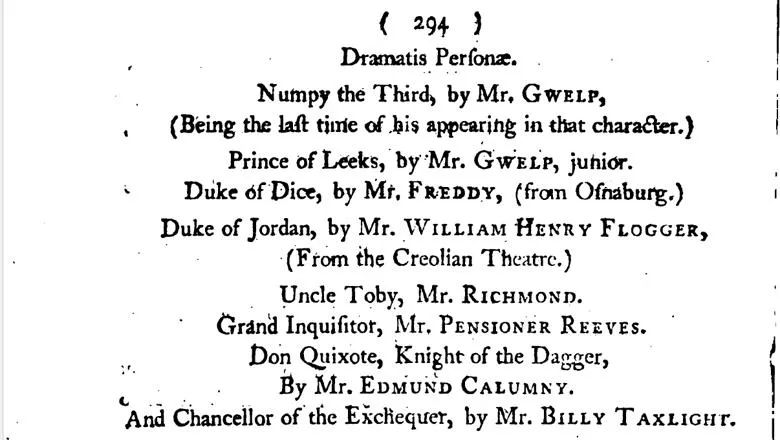
Now, the AHRC-funded collaboration, ‘Radical Translations: The Transfer of Revolutionary Culture between Britain, France and Italy’ – a three-year, collaborative project by the Departments of French and Comparative Literature at King’s College London, which is led by Dr Sanja Perovic – has traced a much earlier usage of this term to a spoof playbill from 1794, antedating its current, recorded first appearance by almost 200 years.
This anonymous playbill appear to be a satirical advertisement for an imaginary farce called, “LA GUILLOTINE; Or GEORGE’S HEAD IN A BASKET!”, which was to be performed, “For the benefit of JOHN BULL, at the FEDERATION THEATRE, in EQUALITY SQUARE, on Thursday the 1st of April, 4971”, featuring as Dramatis personae, “Numpy the Third, by Mr. GWELP (Being the last time of his appearing in that character), Prince of Leeks by Mr. GWELP, junior etc.… The whole to conclude with A GRAND DECAPITATION OF PLACEMEN, PENSIONERS AND GERMAN LEECHES… Vive la Liberté! Vive la République!”.
The playbill was produced as evidence against Thomas Hardy during the 1794 Treason Trials. Hardy was the founder of the London Corresponding Society (LCS), a federation of local political clubs campaigning for the democratic reform of the British Parliament, and his trial, which lasted for nine days from 28 October to 5 November 1794, was the longest and most expensive trial for high treason heard in Britain to that date. This alleged evidence of regicidal intent, produced during the interrogation of a witness, appears to have been suppressed so effectively that no copies appear to have survived. Its contents are only known from the trial transcript published in 1795, and it is possible that it was fabricated by the government to strengthen its case (see notes 1/ and 3/).
While the first recorded usage of ‘Numpy’ actually dates back to a play from 1733, as a term of mocking endearment for a cuckolded husband, this is its first, recorded usage as a satirical nickname for a specified person. Derived from ‘numps’, a 16th-century term for someone characterized as silly or stupid, it appears to be referencing the king’s well-known mental condition. ‘Gwelp’ is a humorous variant on Guelph (or Welf), the original branch from which the House of Hanover dynasty was descended.
The later addition of a ‘t’ to make a more satisfying sound probably derived from the assonant slang phrase ‘Humpty Dumpty’, defined in Francis Grose's Classical Dictionary of the Vulgar Tongue (1785) as, "a short clumsy person of either sex; also ale boiled with brandy". The well-known rhyme appeared a few years later in the English composer Samuel Arnold’s 1797 collection of nursery rhymes set to music, Lady-J


